Transfer Learning: Choose What Learns
Freeze a real ResNet, choose the fine-tuning depth and see every trainable parameter. Turn your choices into PyTorch code.
Explore the labBuild and improve image classifiers with hands-on projects, convolutional networks, transfer learning, and selective fine-tuning.
Lessons, current pricing, and available previews are on Udemy.
A high-level guide to the course. The complete lecture list is available on Udemy.
Set up your environment, get familiar with notebooks, and connect images, labels, and predictions.
Connect the intuition behind learning to manual calculations and then to PyTorch.
Train a convolutional model, examine its confusion matrix, and identify what needs improvement.
Adapt a pretrained ResNet-18, choose which layers to train, and compare meaningful experiments.
Establish a baseline, improve it, compare your models, and explain the mistakes that remain.
Work with downloadable Jupyter notebooks, practice tasks, hints, and completed solutions. Setup guidance and a notebook introduction help you get ready to follow along.
The focus is on reasoning: what changed, why it might help, and what the results actually support. You’ll leave with a workflow you can adapt to your own image-classification tasks.
Try the free model evaluation checklist →Free interactive companions for the course: explore the architecture, choose what learns, vary the data and investigate generalization.
Freeze a real ResNet, choose the fine-tuning depth and see every trainable parameter. Turn your choices into PyTorch code.
Explore the labOpen the stages of ResNet-18, 34 and 50. Follow tensor shapes, compare shortcuts and make the residual addition visible.
Explore the labTransform an image, generate a repeatable batch and inspect each crop, rotation and color adjustment. Decide what should stay invariant.
Explore the labTrain paired neural networks in your browser. Compare measured learning curves, validation errors and the predictions that remain.
Explore the labPython learners who want a practical introduction to computer vision and PyTorch. You should be comfortable with variables, loops, and functions.
No. The course introduces the ideas and connects them to working examples. Basic Python is the starting point.
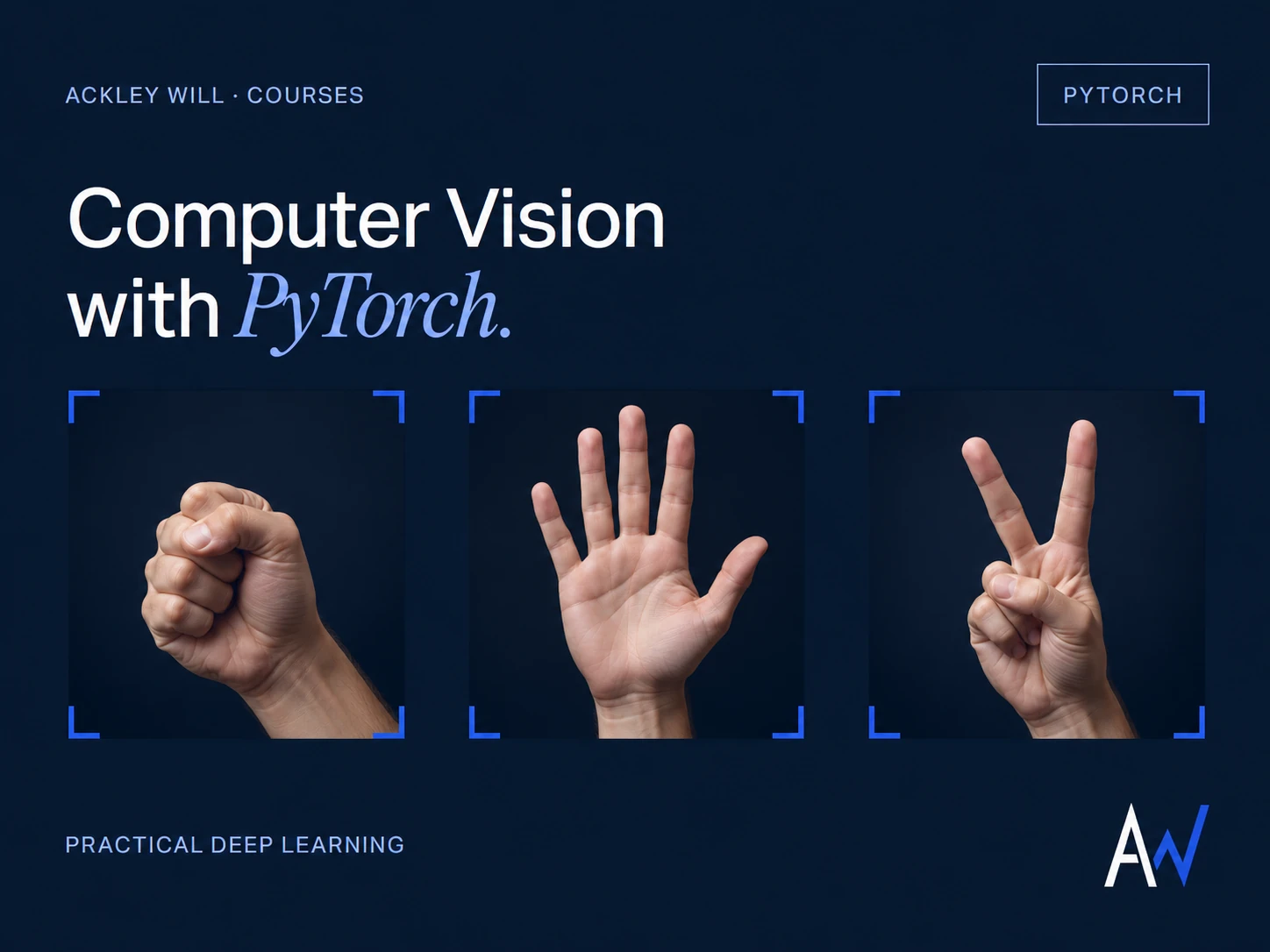
Image classifiers using a baseline CNN, transfer learning, and selective fine-tuning, culminating in a Rock–Paper–Scissors project.
The course, its downloadable materials, available previews, and current purchase options are hosted on Udemy.
The free resources on this site are standalone guides and educational examples. The full guided lessons and course notebooks are available with the course on Udemy.
Learn with Ackley Will, Associate Professor of Computing at Andrews University.